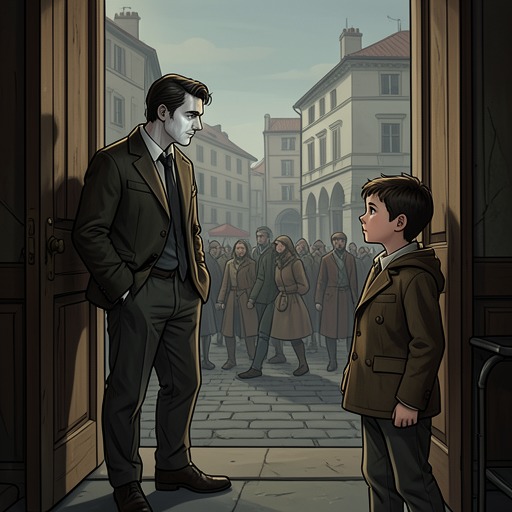
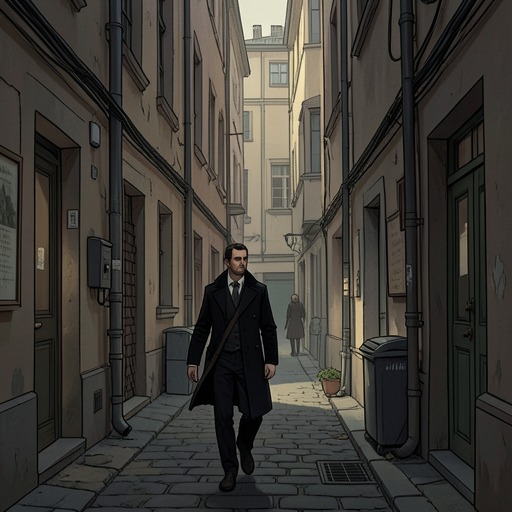
Aschenbach tries to approach Tadzio
Death in VeniceAschenbach tries to approach Tadzio at the moment when a simple greeting might have made their repeated encounters ordinary and open. Instead, he falters just short of contact, discovers that he does not want the sobriety such contact might restore, and lets his private fascination harden into furtive pursuit. The episode turns hesitation into a choice: he abandons the possibility of an ordinary acquaintance in favor of preserving his intoxicating distance.
The Repeated Beach Encounter
By this point, Tadzio has become a constant presence in Aschenbach’s days. The hotel’s limited territory and their regular routines bring the boy into view in its lower rooms, on trips to the city, around the arcades, and, most reliably, on the beach. Aschenbach rises early and takes his place beneath the canopy, watching Tadzio approach the bathing houses or discovering that he is already there, absorbed in the shifting games of the shore. This daily recurrence gives the vacation its peculiar promise: the object of Aschenbach’s attention is not remote but repeatedly, almost predictably, within sight.
The approach occurs on a morning when Tadzio is alone and already heading toward the sea. Seeing an opportunity, Aschenbach considers beginning a casual, friendly acquaintance with the boy who has become the unconscious source of such agitation in him. He wants to address Tadzio and enjoy the answering look in his eyes. The intention is modest in form, but it would change the terms of their relation: instead of remaining a watcher, Aschenbach would have to enter a conversation with the person he has so far turned into an object of contemplation.
Hesitation and Retreat
Aschenbach quickens his pace and catches up with Tadzio on the boardwalk behind the bathing houses. He is on the verge of laying a hand on the boy’s head and shoulders; an amiable phrase in French is ready on his tongue. Yet the closer he comes, the less capable he feels of speaking. His heart pounds, perhaps partly from the rapid walk, and he fears that his voice would emerge tight and trembling. He tries to master himself, then worries that he has been following too closely and will prompt Tadzio to turn and look back at him.
He makes one more effort, fails, and passes the boy with his head bowed. The scene’s reversal is contained in that small movement: the pursuit that seemed to promise contact ends in an evasive withdrawal. Aschenbach immediately thinks that it is too late, but also recognizes that speaking might have put the encounter on a sound, easy footing and restored him to wholesome sobriety. The missed opportunity is therefore not simply imposed by circumstance. It exposes a choice he is already making.
Choosing Intoxication
Aschenbach admits to himself that he does not want sobriety because his intoxication is too precious. The narrative links his hesitation to the uneasy fusion of discipline and licence in the artist: he has lost the habit of examining his impulses and debating whether they arise from conscientiousness or from weakness and dissolution. He is embarrassed by the possibility that someone, even the beach guard, has witnessed his pursuit and defeat, and he fears appearing ridiculous. But embarrassment does not lead him to withdraw from the attachment. He turns the failed approach into a private, joking image of defeat, imagining himself brought down like a rooster before a god whose beauty has broken his courage and pride.
That inward transformation matters more than the greeting he never gives. A direct exchange might have made Tadzio a person with whom Aschenbach had an ordinary acquaintance; the retreat preserves the distance on which his idealization depends. The scene thus makes restraint look double-edged: he stops himself from acting, yet the refusal of contact allows the obsession to continue without the corrective demands of actual conversation.
From Watching to Pursuit
After the failed approach, Aschenbach no longer thinks about the date when his planned holiday will end, and the thought of going home does not occur to him. He sends for a generous supply of money and worries instead that the Polish family might leave. His days remain organized around Tadzio’s presence, while his nights become short and restless. At dawn he rises to watch the sun, and the returning emotions of his earlier life take on new forms in his imagination. The missed greeting therefore belongs to a widening surrender of his old routines, not to an isolated moment of shyness.
The attachment eventually passes from repeated observation into secret pursuit. In Venice, Aschenbach hides among the crowd as Tadzio and his companions leave a church, then follows them through the streets, stopping when they stop and ducking into shops and courtyards when necessary. When they board a gondola, he hides behind a well, hires another gondola, and directs its rower to follow at a distance. The earlier fear that Tadzio might turn around and question his closeness has become conduct organized around remaining unseen. Aschenbach is now, in the narration’s terms, drunk and following an impulse that tramples reason and dignity.
Ending and Significance
The contrast between the first approach and the later pursuit is stark. On the beach, Aschenbach cannot bear the thought of being noticed while walking too close; later, he deliberately arranges to follow Tadzio through the city and across the water. What began as an unrealized possibility of friendly speech becomes a concealed chase, with the boy’s presence governing Aschenbach’s movements while their relationship remains one-sided.
At the end, Aschenbach watches Tadzio move alone across a sandbank, separated both from the mainland and from his companions. When the boy looks back, Aschenbach imagines that he is smiling, nodding, and beckoning him onward. The imagined invitation continues the pattern established by the failed approach: Aschenbach reads meaning into a look but never obtains an answering conversation. He rises as if to follow, then collapses in his chair. Help comes only after several minutes, and he is brought to his room; that same day, news of his death is received by a shocked world. The approach’s failure thus foreshadows the final form of his attachment: a movement toward Tadzio sustained by Aschenbach’s interpretation, ending not in mutual contact but in death.